



Ask a business graduate in San Diego what they're doing next. You'll likely hear about launching a startup or landing an entry-level finance job in one of San Diego’s booming industries. But rarely do they mention accounting.
Traditionally, accounting has a reputation of monotonous number crunching with balance sheets and ledgers. But modern accounting is much more dynamic. Accounting professionals today act as strategic business advisors, leveraging tools like predictive analytics and forensic auditing.
In San Diego in particular, such modern accountants are in high demand. Every biotech startup in Torrey Pines, every real estate fund downtown, every hotel group along the coast needs someone who understands the numbers. If you’re unsure of your career path, the accounting profession may have the answers you’re looking for.
If you’re considering whether it’s too soon for a career pivot, you may already be closer than you think. A Master of Accountancy (MACC) degree can put you on the path to a CPA in under one year — and you don’t need a bachelor’s in accounting.

Photo credit: Unsplash @iyan-ryan
San Diego's Accounting Scene
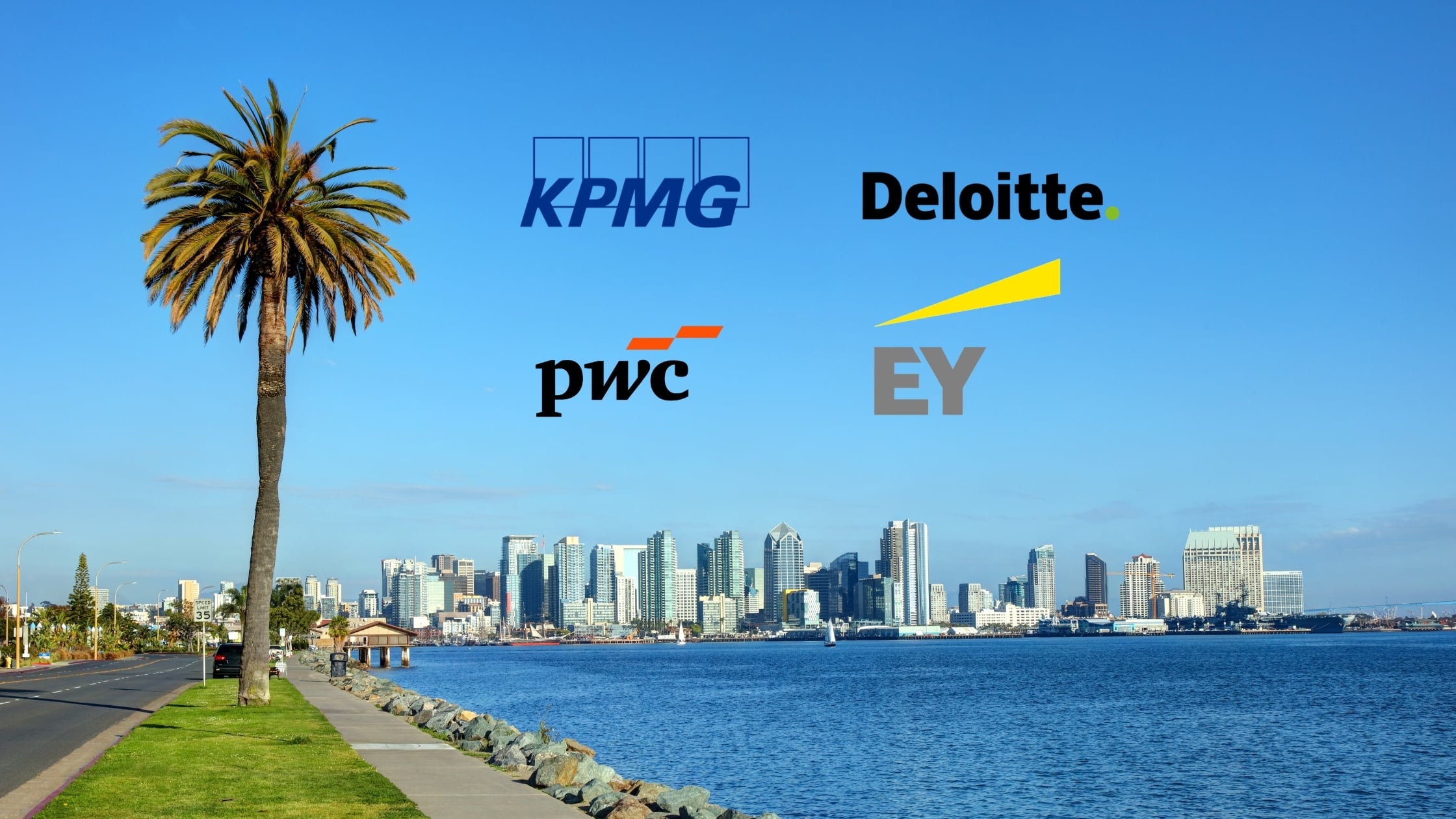
The Big 4 accounting firms — Deloitte, EY, KPMG, PwC — are all established in San Diego. San Diego is also home to a dense bench of respected regional and boutique firms. That range means new accountants in San Diego get to choose among different firm cultures, client rosters, and career speeds. Here’s a roundup of accounting firms in San Diego with national, regional, and local reach.
National Accounting Firms with San Diego Offices
Regional Firms with San Diego Offices
- Aldrich
- Moss Adams - merged with Baker Tilly in 2025
San Diego-Based Accounting Firms
- CFO Hub - now part of Carr, Riggs, & Ingram
- Considine & Considine
- Haskell & White
Local Industries Shape Your Accounting Acumen
Accounting in San Diego is shaped by the industries the city is known for. You don’t need expertise in these fields to enter the accounting profession, but through the work you do, you’ll learn key insights about how they operate.
As the third largest hub for life sciences and biotech, accounting auditors ensure these companies remain compliant with not only financial practices, but environmental social governance (ESG) reporting requirements as well — California leads the nation in climate impact disclosure laws.
A fast-growing real estate market and robust tourism industry means accounting professionals are always in demand to support accurate financial reporting. San Diego also has a significant nonprofit sector, which presents its own unique needs for accounting services, including maintaining strict regulatory compliance to preserve their 501 nonprofit status and prevent fraud.
Geographically, San Diego’s location on the U.S.-Mexico border and across the Pacific Ocean from the Asia-Pacific Rim region means that many businesses here engage in international transactions, adding complexity to accounting work for San Diego firms.
Big Four, Boutique, or Private: Three Career Paths
According to Sarah Lyon, an accounting professor at the University of San Diego's Knauss School of Business, the majority of accounting grads start in public accounting, most commonly on the audit side (tax is often a specialized track). From there, career paths generally split three ways:
- Big Four (Deloitte, EY, KPMG, PwC): Structured training, resume-building brand recognition, and exposure to San Diego's largest public and private companies
- Mid-size and boutique firms: Closer client relationships, often a faster runway to the partner track, and more room to specialize early. Entrepreneurially minded CPAs might start their own firms.
- Private industry: In-house accounting support as payroll specialists, accounting analysts, and controllers at companies headquartered here (Qualcomm, San Diego Padres, Illumina, Port of San Diego, etc.)
A smaller share of accounting professionals land in government roles working at the IRS or a county auditor's office. And if your goal is to eventually become a controller or CFO, that path almost always passes through the public accounting track first.
One practical detail to know early on: you don't need a CPA license to start in public accounting, but you'll need it to move from a staff level to a senior role, usually around year three or four. Getting licensed early isn't just a formality, it's the difference between staying on track for promotion and stalling out.
A Different Kind of Office Culture

Interior of Deloitte San Diego Office, Photo Credit: Turner Construction
Professor Lyon also noticed something students bring up unprompted: San Diego's accounting community is smaller, yet active, creating plenty of opportunity for authentic connections and collaboration. She recalls a recent graduate, barely two years into his career, telling her he already knows someone at every firm in town. That's not unusual here.
Students also describe San Diego offices as more laid-back than what they've seen touring and interning at firms in the Bay Area or New York: more casual dress, more approachable managers, an atmosphere that feels like it belongs to this city rather than importing one from somewhere else. It's a small thing, but in a profession people sometimes assume is buttoned-up everywhere, it's a real differentiator.
Where to Build Your Network

CalCPA San Diego ABC Night, Photo Credit: Instagram @calcpa_sandiego
CalCPA's local chapter is a membership-based group for emerging and established accounting professionals in San Diego that offers networking and professional development events:
- Networking nights at venues like the Riverwalk Golf Club and Bali Hai
- CPE credit events (Continuing Professional Education for CPAs)
- CalActive Group for sports tournaments and hikes
- North County Discussion Group
- CalCPA Members Club Summit - San Diego hosted the 2026 conference, which rotates to different California cities each year
If You're Ready to Pivot into Accounting
If a career in accounting sounds like a fit but your degree isn't in accounting, a few graduate programs in San Diego can get you there in about a year:
University of San Diego (USD): The Knauss School of Business’ Master of Accountancy (MACC) runs 10–12 months and is built for students without an accounting background, including non-business majors. STEM-designated with the option to specialize in business analytics. Learn more about USD's MACC program.
San Diego State University (SDSU): The Charles W. Lamden School of Accountancy offers a Master of Science in Accountancy, a flexible 12–18-month program with four specialization tracks. Explore SDSU's MSA program.
Point Loma Nazarene University (PLNU): A newer on-campus Master of Science in Accounting, launched in 2025, rounds out the local options. See PLNU's accounting program.
Whichever path you look into first, the takeaway is the same: San Diego doesn't just have accounting jobs — it has a genuine accounting community, and more ways to break into it than most people realize.