




For many organizations, supply chain management has traditionally been reactive. Companies address disruptions after they occur, adjust inventory when shortages emerge and respond to changing demand only after it affects regular operations.
In today's fast-moving and increasingly complex business environment, that approach is no longer enough.
The shift toward predictive supply chains was already underway before the rise of artificial intelligence. Organizations began using data and analytics to anticipate demand, identify risks and improve decision-making. AI has only accelerated that movement, helping businesses process larger amounts of information and respond with greater speed and accuracy.
Artificial intelligence in supply chain management is fundamentally changing how companies plan, move and respond. By turning data into predictive insights, AI is helping organizations build more efficient and resilient supply chains.
What Is AI in Supply Chain Management? Why Does It Matter Now?
Organizations and businesses use AI in supply chain management to analyze data and identify patterns within it to support faster, more informed supply chain decision-making. AI systems can process large amounts of information to improve forecasting, optimize operations and help organizations respond to changing conditions.
Several core technologies fall under the AI umbrella in this context:
- Machine learning: Systems that learn from historical and real-time data to improve predictions and recommendations over time.
- Predictive analytics: Tools that forecast demand, inventory needs and potential disruptions before they affect operations.
- Natural language processing (NLP): Technology that can automate tasks such as supplier communications, contract analysis and reporting.
- Computer vision: Systems that support warehouse automation, quality control and inventory tracking through cameras and image recognition.
These technologies are gaining momentum as supply chains become increasingly interconnected and reliant on data analytics to succeed. The global market for AI in supply chain management has grown rapidly, increasing from approximately $6.5 billion in 2022 to nearly $20 billion in 2026, with projections surpassing $70 billion by 2030. As organizations seek resilience and efficiency, AI is quickly becoming an essential component of modern supply chain strategy.
Real-Life AI in Supply Chain Examples
While AI in logistics and supply chain management has incredible potential, we can see its greatest impact where organizations are already putting these technologies to work. Across retail, manufacturing and global logistics, companies are using AI to improve visibility and automate decision-making.
Retail
Walmart has integrated AI into its inventory management system, using predictive analytics to forecast demand with greater accuracy, optimize stock levels and reduce waste, achieving a 15–20% reduction in inventory costs while improving product availability and customer satisfaction.
Manufacturing
A medical device manufacturer is using AI agents to empower category managers through automated supplier scoring and quote validation, while a transportation company has deployed agentic workflows that request quotes from approved suppliers and rank responses autonomously.
Global Logistics
Leading companies are using generative AI and digital twins to simulate thousands of what-if scenarios, optimize safety stock and identify single-source risks across global supply networks.
How Can AI Enhance Sustainability in Supply Chains?
Sustainability and supply chain management have become increasingly inseparable. Regulatory requirements, growing consumer expectations and board-level environmental goals are making sustainable operations a business imperative rather than just a corporate values statement.
Organizations are now expected to improve efficiency while also reducing waste, emissions and environmental impact across their supply networks.
AI in supply chain management can support these efforts in several ways:
- Reducing waste through smarter forecasting: More accurate demand predictions help organizations avoid overproduction, excess inventory and unnecessary waste.
- Optimizing transportation routes: AI-powered logistics tools can identify more efficient delivery routes, reducing fuel consumption and emissions.
- Improving warehous energy efficiency: Intelligent systems can optimize lighting, heating, equipment usage and inventory movement to reduce energy consumption in warehouses and distribution centers.
- Evaluating supplier sustainability: AI can analyze supplier performance data and help organizations assess environmental practices, compliance and sustainability risks throughout the supply chain.
- Tracking carbon emissions: AI tools can collect and analyze operational data to measure carbon footprints and identify opportunities to reduce environmental impact.
As organizations pursue both operational excellence and responsible business practices, AI is becoming an important tool for building more sustainable supply chains. For more insights, read our blog on sustainable supply chain management.
The Future of AI in Supply Chain
As more businesses adopt AI technology to support their operations, supply chain professionals will work alongside intelligent systems for analytics and automate routine tasks. The next wave of innovation is not focused on replacing human expertise, but on expanding what supply chain teams can accomplish.
Several trends are beginning to shape the next phase of AI adoption:
- Agentic AI systems are becoming more capable of completing multi-step tasks and supporting routine supply chain decisions.
- More organizations are using digital twins at scale to test scenarios, evaluate risks and improve planning before making operational changes.
- Human-plus-machine workflows can provide insights and recommendations, while supply chain professionals continue to provide context, judgment and strategic direction.
- As data becomes more connected across suppliers, logistics and operations, unified data platforms give organization gain greater visibility into their supply chains.
The future of supply chain management will depend on professionals who can understand these technologies and apply them strategically to solve complex business challenges.
The Future of Supply Chain Is Already Here: Be Prepared With An MSSCM
AI in supply chain management is no longer a future-state concept. Across industries, organizations are already using AI to improve forecasting, optimize inventory, manage suppliers and strengthen global operations.
The shift from reactive to predictive decision-making is becoming one of the defining changes in modern supply chain management, and AI is helping to make that transformation possible.
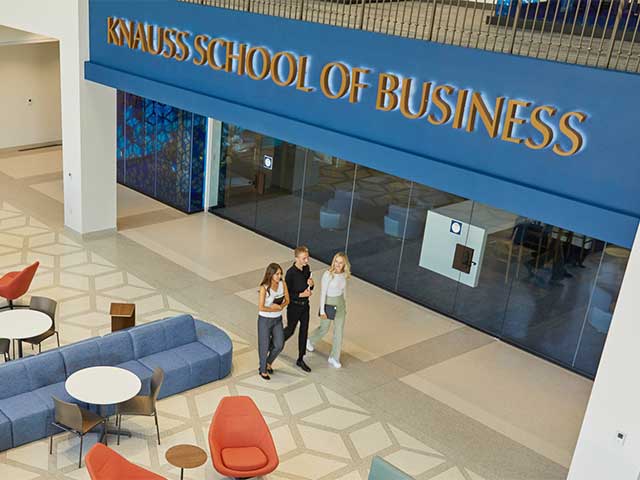
Tomorrow’s organizations need leaders who can combine technical knowledge with strategic business thinking. The Master of Science in Supply Chain Management at the Knauss School of Business prepares graduates to manage the next generation of global operations and lead in a data-driven business environment.
Recent outcomes from the program demonstrate the value of these skills in today's marketplace:
- Average starting salary of recent MSSCM graduates (2024): $113,478
- Average salary for previously employed graduates who received a promotion (2024): $99,355
- 95% of 2024 MSSCM graduates were employed within six months
Whether your goal is to advance within your current organization or prepare for new opportunities in supply chain leadership, the Knauss School of Business provides the knowledge, experience and industry perspective needed to succeed.
Ready to take the next step?